Friday, March 16, 2012

"Spotted: Anthony Davis's Mom Wearing A Unibrow Mask, And It Looks Eerily Good"


     http://www.sportsgrid.com/ncaa-basketball/anthony-davis-unibrow-mask/


     This article is extremely funny as it makes fun of the fact that Anthony Davis of the Kentucky basketball team is sporting a unibrow, and not afraid to show it off.  According to the author of this article "true power comes from owning your brow, not banishing it".  Not only does Davis rock the unibrow, but his mom also wears a mask during games that has a unibrow drawn on it.  I found this article hilarious and if you would like to see funny pictures of his uni go to: http://www.thepowerwire.com/the-power-blog/2012/3/11/bow-to-the-brow-a-tribute-to-uk-star-anthony-davis-unibrow.html  (It's worth it).
     The author of this article doesn't use much rhetoric because this article was meant to be sarcastic.  Yet if I was forced to choose one rhetorical appeal, I guess I would say ethos.  The reason for this is that as Americans we like to look clean and groomed.  Also, athletes, especially college athletes are usually well dressed and clean cut so Davis is definitely going against the norm.

Thursday, March 8, 2012

"Why African-American QB's Are Systematically Trained to Abandon Mechanics"

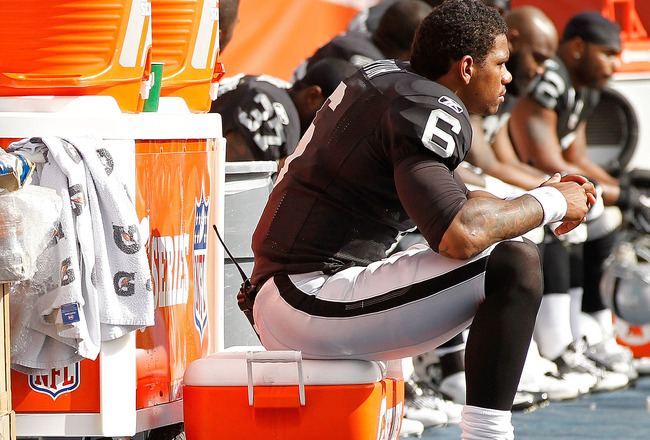
MIAMI GARDENS, FL - DECEMBER 04:  Terrelle Pryor #6 of the Oakland Raiders looks on  during a game against the Miami Dolphins at Sun Life Stadium on December 4, 2011 in Miami Gardens, Florida.  (Photo by Mike Ehrmann/Getty Images)
http://bleacherreport.com/articles/1089725-why-african-american-qbs-are-systemically-trained-to-abandon-mechanics


     This article is about how African-Americans are often considered "dual threat" quarterbacks rather than "pro-style" quarterbacks.  The author suggests that this is due to stereotypes and what he calls "barriers".  "The barriers that African American quarterbacks must surmount to succeed in the NFL are no longer explicit. But, like in the rest of society, just because the barriers are hard to see doesn't mean they aren't there".  Within the article, there were pictures of the top 15 "Pro Style" quarterbacks in the 2012 college recruiting class and the top "Dual-Threat" quarterbacks in the 2012 college recruiting class.  Just as the author suggested, almost all the Dual-threat QB's were African-American, while all of the Pro Style QB's were white.  The author went on to say that this is due to bias and preconceptions.  i don't know if I agree with the author completely in this article but I liked this article because it covers a topic that is not often discussed in football.
     The author of this article used mostly ethos as a rhetorical appeal.  He did so because he was questioning the way in which we grade athletes and what the color of their skin has to do with it.  For example, he wrote, "The image of the Golden Boy quarterback is firm in our minds: tall, lean, cannon arm. Handsome, clean-cut, dates the cheer captain. Stays in the pocket, stays cool under pressure. Confident, outgoing, looks you right in the eye and shakes your hand. Well spoken. Makes good decisions. Smart. White."  Parts of the article, such as this, really make the reader question the way he/she thinks.

Sunday, March 4, 2012

Star-To-Be Who Never Was


http://www.nytimes.com/2012/03/04/sports/basketball/lenny-cooke-star-to-be-who-never-was.html?pagewanted=1&_r=1&ref=sports


     This article is about a man named Lenny Cooke.  It is a sad article but it teaches some important life lessons.  Cooke was one of the top high school prospects at one point yet had a slow downfall due to poor decisions and injuries.  Cooke should have stayed in school and waited to improve in basketball but he didn't so when he didn't get drafted in the NBA draft, he was in awe.  One thing led to another, including a car crash, and two torn achilles and there was nothing left for him.  It was such a sad story and makes you think of how important an education is.
     Obviously, the author of this article used pathos the most.  This article really tugged at the heart and made the reader think hard about the decisions we are forced to make in life.  The author attempted to make the end of this article happy, but there was not point in doing so.  In a way, the damage was already done.  Unfortunately, not all stories turn out happy in the end, and this is one of them.